

Remember when your teenager couldn’t wait to see their friends or spend the weekend doing something they loved? Now, they barely leave their bedroom. Their grades may be slipping, conversations may turn into arguments, and when you ask what’s wrong, the answer is usually “nothing” or “I don’t know.”
It’s difficult to watch your child withdraw without understanding why. Depression in teenagers can involve persistent sadness, irritability, or a loss of interest in daily activities that lasts for weeks. It isn’t simply a difficult phase of adolescence, and it can affect how your teen thinks, feels, and functions at home or school (1).
Bloom Adolescent Health provides teen depression treatment in Natick, Massachusetts, for adolescents ages 11 to 18. Our partial hospitalization program (PHP) and intensive outpatient program (IOP) offer structured therapy and psychiatric care for teenagers who need more support than traditional weekly counseling.
As part of our broader mental health treatment for adolescents, we help teens develop coping skills, rebuild daily routines, and work through the challenges associated with depression.
Depression can sometimes involve thoughts of suicide or self-harm. If your teenager talks about wanting to die, expresses an intention to end their life, has a suicide plan, or is actively hurting themselves, take these concerns seriously.
If your teen is in immediate danger, call 911 or go to the nearest emergency room. You can also call or text 988 to reach the Suicide & Crisis Lifeline.
Teens who have active suicidal intent or cannot remain safe at home may need emergency evaluation or inpatient psychiatric care before entering an outpatient program.
Bloom may be an appropriate next step once a teenager is stable enough to return home safely after treatment sessions.
Learn more about support for teen self-harm and suicidal thoughts.
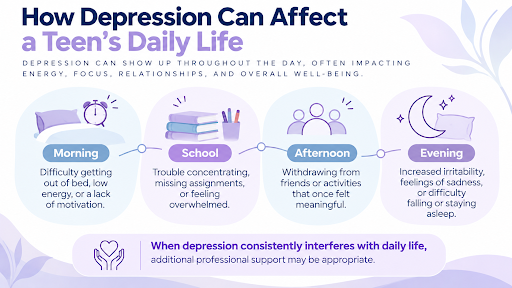
It isn’t always obvious when your teenager needs more support than weekly therapy. Some adolescents continue going to school and spending time with family while privately struggling with depression. Others experience changes that make everyday responsibilities increasingly difficult.
According to the National Institute of Mental Health (NIMH), adolescent depression may involve irritability, changes in sleep, difficulty concentrating, withdrawal from friends, and declining school performance (1).
You might notice your teenager sleeping through much of the afternoon, missing assignments in several classes, or abandoning a sport they’ve enjoyed for years. Perhaps they’re spending less time with friends, becoming easily frustrated, or responding to ordinary questions with anger.
These changes don’t automatically mean your teenager has depression. However, persistent symptoms that interfere with their daily life deserve professional attention.
A structured teen depression program may be appropriate when:
The goal isn’t to place every teenager experiencing depression into an intensive program. It’s to determine whether their current level of support matches their needs.
Bloom’s PHP and IOP provide treatment for teens who can safely return home each day. Adolescents who need continuous supervision or immediate psychiatric stabilization may require inpatient care first.
For more information about recognizing depression, read our article on signs of depression in teens. You can also learn about what happens when depression goes untreated.
Two teenagers with depression may need very different amounts of support. One might struggle to get out of bed or attend school, while another continues going to class but feels increasingly disconnected from friends and family.
Bloom offers two levels of outpatient depression treatment for teens. Both provide structured therapeutic services during the day, but they differ in the amount of treatment and support provided.
Our partial hospitalization program provides a higher level of outpatient care for adolescents experiencing depression that significantly affects their ability to manage daily activities.
PHP runs Monday through Friday, from 9 AM to 3:30 PM.
This program may be appropriate for teenagers who are unable to participate consistently in school, struggle with basic routines, or need intensive therapeutic support after leaving an inpatient psychiatric setting.
During PHP, teens participate in a combination of therapeutic services throughout the day before returning home in the afternoon.
Our IOP provides structured treatment for adolescents who need more than weekly therapy but don’t require a full day of clinical programming.
IOP runs from 9 AM to 12:30 PM, three, four, or five days per week, depending on the teenager’s individual needs.
For example, a teen who continues attending school but is struggling with persistent low mood, declining motivation, and growing social isolation may benefit from IOP.
Some teenagers begin treatment in IOP, while others transition from PHP as their symptoms improve and they need less intensive support.
Determining the right program involves looking at your teen’s symptoms, safety, daily functioning, and previous treatment experiences. For additional information, read our article comparing PHP and IOP.
A teenager experiencing depression may understand that something is wrong without knowing how to explain it. They might have difficulty identifying their feelings, finding the motivation to make changes, or believing that treatment will help.
At Bloom, we use several therapeutic approaches to help adolescents understand their emotions, practice coping strategies, and work toward meaningful changes in their daily lives.
Treatment may include individual therapy, group sessions, family involvement, experiential activities, and psychiatric care.
Cognitive behavioral therapy helps teenagers recognize negative thought patterns and understand how those thoughts influence their feelings and actions.
For example, a teen who believes they’re a failure because their grades have dropped may work on challenging that belief and developing a more realistic perspective.
CBT can also help adolescents identify small, manageable actions that support healthier daily routines, even when motivation is low.
Dialectical behavior therapy (DBT) focuses on emotional regulation, distress tolerance, and communication skills. These approaches can help teens respond to overwhelming feelings without withdrawing further or reacting impulsively.
Evidence-based psychotherapy, including CBT, is among the treatments recommended in clinical guidelines for adolescent depression (2).
Depression can make teenagers feel disconnected from people who care about them. Some struggle to describe their feelings, while others assume their experiences are too personal for anyone else to understand.
Individual therapy provides private time to work with a therapist on emotional concerns, negative thinking patterns, and personal goals.
Group therapy gives adolescents opportunities to connect with peers experiencing their own mental health challenges. Through guided discussions and therapeutic activities, teens can practice communication skills, express themselves, and learn from different perspectives.
For teenagers who have been withdrawing socially, these interactions may provide a supportive setting for rebuilding confidence in relationships.
Living with a teenager who has depression can be confusing and frustrating. You may want to encourage them to get out of bed, spend time with friends, or participate in family activities, only to find that your efforts lead to arguments or more withdrawal.
Through family therapy, Bloom helps parents and caregivers better understand depression and develop ways to communicate with their teenager.
This may involve learning how to respond when your teen isolates themselves, setting reasonable expectations, or finding ways to offer support without turning every conversation into a disagreement.
Family involvement is also emphasized in clinical guidelines for adolescent depression, which recognize the importance of including parents and caregivers in assessment and treatment planning when appropriate (2).
Traditional talk therapy isn’t always the easiest way for a teenager to express difficult feelings. Some adolescents become quiet, frustrated, or uncomfortable when asked to explain their emotions directly.
Bloom offers experiential therapy activities such as expressive arts, music, drama, and movement. These activities provide additional opportunities for teenagers to participate in treatment and explore their experiences.
Animal-assisted therapy may also be incorporated into therapeutic activities, giving teens another way to engage when conversation feels difficult.
These approaches complement other therapeutic services and provide different ways for adolescents to participate in their care.
Every teenager entering treatment at Bloom receives an initial psychiatric evaluation.
This evaluation helps clinicians understand their symptoms, review treatment needs, and determine whether medication should be considered.
When medication is prescribed, Bloom provides weekly or biweekly medication management to monitor symptoms, assess how the teen is responding, and address concerns.
Not every adolescent with depression requires medication. Treatment recommendations depend on the individual’s clinical assessment and needs.
You may have been hoping that your teenager’s mood would improve on its own or that another few weeks of counseling would make a difference. When depression continues to interfere with their life, it’s reasonable to explore additional treatment options.
Bloom Adolescent Health provides depression treatment for teens ages 11 to 18 at 235 West Central St, Natick, MA 01760.
Call (781) 427-2634 to speak with our admissions team about what your family is experiencing. We’ll talk with you about your concerns, answer questions about PHP and IOP, and help you understand your insurance coverage.
You can also begin by verifying your insurance online to explore your benefits for adolescent mental health treatment.
Bloom’s partial hospitalization program runs Monday through Friday, from 9 AM to 3:30 PM. During the day, teenagers participate in a combination of individual therapy, group therapy, coping skills development, and other therapeutic activities. The specific services they receive depend on their treatment needs. Teens return home after their scheduled programming.
It’s understandable for teenagers to feel uncertain, frustrated, or resistant when parents suggest mental health treatment. Depression itself can affect motivation and make it difficult to believe that things can improve. Listen to your teenager’s concerns, explain why you’re worried, and avoid turning the conversation into an argument. Bloom’s admissions team can help you understand what treatment involves so you can discuss the options with your teen.
Traditional outpatient therapy generally involves periodic appointments with a therapist. PHP and IOP provide more frequent, structured treatment that may include individual counseling, group therapy, family involvement, and psychiatric care. These programs are designed for teens who need more clinical support than weekly sessions can provide.
Inpatient psychiatric treatment provides continuous supervision in a hospital or similar setting. Bloom’s PHP and IOP are outpatient programs, meaning teenagers attend scheduled treatment sessions and return home afterward. Inpatient care may be necessary when a teen cannot remain safe at home, while PHP or IOP may be appropriate when they need structured treatment without overnight supervision.

Simone “Momo” is a sweet 2-year-old Lab mix who believes life is best spent doing three things: snuggling, napping, and playing with her toys—then repeating the whole process!
She absolutely loves her treats, but there’s one snack that has her heart: blueberries! Whether she’s curled up beside her favorite people or happily playing with her toys, Simone is happiest when she’s surrounded by love, comfort, and plenty of cuddles.

Richie is a 5-year-old Mini Goldendoodle who has a few favorite things: getting spoiled with pets, scoring tasty treats, playing with his favorite toys, and snuggling up close!
He’s got a big personality, an even bigger heart, and plenty of love to share.