

Maybe you’ve noticed that your teenager takes longer and longer to get ready for school. They might check their homework repeatedly, ask you the same question several times, or become deeply upset when a familiar routine changes. You may have tried offering reassurance or encouraging them to move on, only to find that the same concerns return.
For teens with obsessive-compulsive disorder (OCD), these behaviors aren’t simply habits or preferences. OCD involves unwanted, recurring thoughts called obsessions and repetitive actions or mental rituals called compulsions. These experiences can consume significant time, cause distress, and interfere with everyday activities (1).
Bloom Adolescent Health provides teen OCD treatment in Natick, Massachusetts, for adolescents ages 11 to 18. Through our partial hospitalization program (PHP) and intensive outpatient program (IOP), we offer structured mental health care that helps teenagers develop coping skills, manage difficult emotions, and receive support beyond traditional weekly counseling.
Our OCD services are part of Bloom’s broader adolescent mental health care programs.
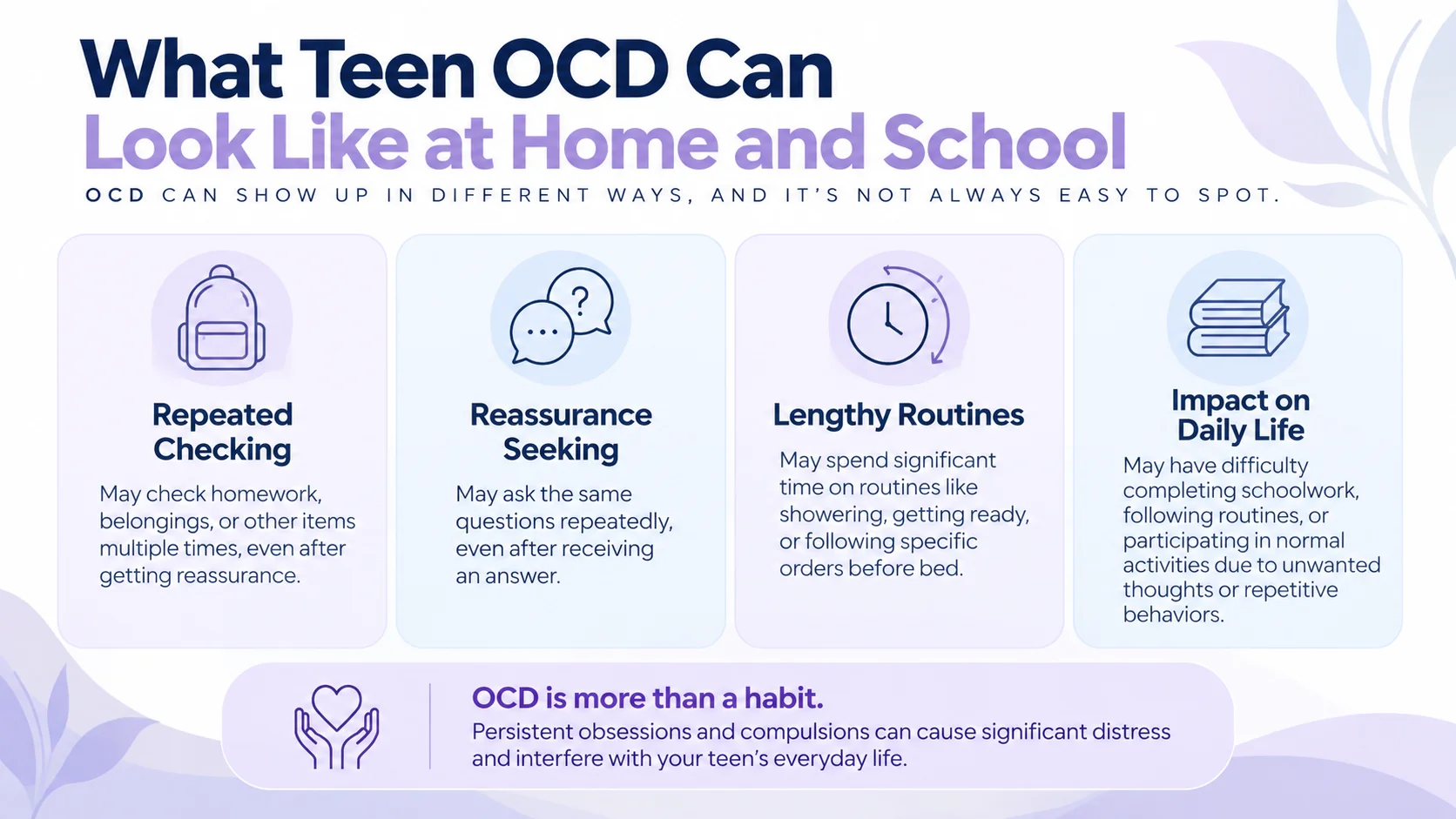
OCD isn’t always obvious, especially when teenagers make an effort to conceal their thoughts or behaviors. Some adolescents recognize that their concerns seem unreasonable but still feel compelled to follow certain routines.
For example, a teen may spend an hour rewriting a homework assignment because it doesn’t feel quite right. Another might repeatedly check their belongings before leaving home, causing the family to run late almost every morning.
Other signs may include:
According to the National Institute of Mental Health (NIMH), people with OCD may recognize that their compulsions are excessive but still struggle to control them. These thoughts and behaviors can take up substantial portions of the day and interfere with school, relationships, and other responsibilities (1).
Some teenagers also experience anxiety or depression alongside OCD. These overlapping symptoms can make it more difficult for parents to understand what their teen is experiencing.
If your teenager is struggling with persistent fears or worry, you can also learn about Bloom’s teen anxiety treatment services.
Not every teenager with OCD requires intensive outpatient treatment. Some adolescents can manage their symptoms through traditional weekly counseling and appropriate clinical support.
However, when compulsions begin taking over your teenager’s schedule or making it difficult to participate in normal activities, additional treatment may be appropriate.
You might consider a structured OCD program for teens if:
These challenges can gradually become part of a family’s routine. You may find yourself changing plans, answering the same questions, or helping your teenager complete certain tasks to avoid an emotional reaction.
When OCD symptoms are affecting the entire household, a more structured treatment program can provide support for both your teen and your family.
Bloom’s PHP and IOP are intended for adolescents who need additional therapeutic care but can safely return home after treatment sessions. Teens who require continuous psychiatric supervision or cannot remain safe at home may need inpatient care first.
If your teenager is in immediate danger, call 911 or go to the nearest emergency room. You can also call or text 988 for crisis support.
A clinical assessment can help determine whether Bloom’s outpatient programs are appropriate for your teenager’s symptoms, safety, and individual needs.
The amount of support a teenager needs depends on how significantly OCD affects their daily functioning.
One teen might continue attending school while struggling with repetitive thoughts and behaviors. Another may spend so much time completing rituals that getting through a normal school day has become nearly impossible.
Bloom Adolescent Health offers two levels of structured outpatient mental health treatment.
Our PHP provides intensive daytime care for teenagers whose OCD symptoms significantly interfere with school attendance, family routines, or other responsibilities.
PHP operates Monday through Friday, from 9 AM to 3:30 PM.
During treatment, teens participate in structured therapeutic activities designed to support emotional regulation, coping skills, and healthier ways of managing daily challenges.
PHP may be appropriate when weekly counseling isn’t providing enough support or when a teenager needs continued care after an inpatient psychiatric stay.
Our IOP offers structured treatment with fewer weekly hours than PHP.
IOP runs from 9 AM to 12:30 PM, three, four, or five days per week, depending on your teen’s needs.
This program may be appropriate for adolescents who can manage some daily responsibilities but continue experiencing OCD symptoms that require more frequent therapeutic support.
Some teenagers begin with IOP, while others transition from PHP as their symptoms improve.
The right program depends on your teenager’s clinical assessment and individual circumstances. You can also read more about which program fits your family’s needs.
OCD can be frustrating for teenagers who recognize that their thoughts or behaviors are interfering with everyday life. They may want to stop repeating certain actions but feel overwhelmed by anxiety or discomfort when they try to change their routines.
At Bloom, treatment focuses on helping teens understand their emotional responses, practice coping skills, and receive support in managing symptoms.
Our programs may include cognitive behavioral therapy (CBT), dialectical behavior therapy (DBT) skills, individual and group therapy, family involvement, and psychiatric care.
Cognitive behavioral therapy helps teenagers recognize patterns of thinking that contribute to distress and develop healthier ways to respond.
For example, a teen who experiences recurring unwanted thoughts may work on recognizing those thoughts without automatically accepting them as facts.
DBT skills focus on managing difficult emotions, tolerating distress, and developing more effective ways to communicate.
These approaches can help adolescents recognize uncomfortable feelings and practice coping strategies when OCD symptoms become overwhelming.
CBT is among the established psychotherapeutic approaches used in OCD treatment, although specific treatment methods depend on clinical training and individual needs (2).
Learn more about CBT and its role in adolescent mental health care.
Parents naturally want to make life easier for their children. When your teenager experiences intense anxiety around certain routines, you may find yourself repeatedly offering reassurance, changing household routines, or completing tasks for them to prevent distress. Over time, these responses can become a pattern known as family accommodation, which occurs when family members adjust their behavior to participate in or support OCD-related rituals.
Through family therapy, Bloom helps parents recognize these patterns and develop more supportive ways to respond. This doesn’t mean suddenly withholding reassurance or demanding that your teenager abandon familiar routines. Instead, a qualified clinician can help your family make thoughtful changes that account for your teen’s symptoms and emotional needs.
Family involvement also helps you better understand OCD and learn how to support the coping skills your teenager is developing in treatment.
Teenagers experiencing OCD may feel embarrassed by their symptoms or worry that other people won’t understand their experiences.
Group therapy provides opportunities to connect with peers who are managing their own mental health challenges.
During guided sessions, adolescents can practice communication, discuss emotions, and develop coping skills in a supportive setting.
Group therapy also gives teens opportunities to participate in therapeutic activities without having to explain every personal thought or experience to others.
Every teenager entering treatment at Bloom receives an initial psychiatric evaluation.
This evaluation helps clinicians assess their symptoms, review mental health concerns, and determine whether medication should be considered as part of treatment.
When medication is prescribed, Bloom provides weekly or biweekly medication management to monitor the teen’s response, address concerns, and make adjustments when clinically appropriate.
Medication isn’t automatically included in every treatment plan. Recommendations depend on each adolescent’s individual needs and psychiatric evaluation.
If you’ve spent months adjusting your family’s routines around your teenager’s OCD symptoms, you may be wondering whether things can change. You don’t have to decide on the right treatment program without professional guidance.
Bloom Adolescent Health provides outpatient OCD treatment for teens ages 11 to 18 at 235 West Central St, Natick, MA 01760.
Reach out online or call (781) 427-2634 to speak with our admissions team about your teenager’s symptoms and learn whether PHP or IOP may be appropriate. We’ll discuss your concerns, answer questions about our programs, and help you understand your coverage.
You can also verify insurance online to check your benefits for adolescent mental health treatment.
Medication may be included when clinically appropriate, but not every teenager with OCD requires it. Each adolescent entering Bloom receives an initial psychiatric evaluation. When medication is prescribed, weekly or biweekly medication management helps monitor symptoms, evaluate the teen’s response, and address concerns.
Start by discussing your family’s routines with a qualified mental health professional rather than making sudden changes on your own. Family accommodation can develop gradually as parents try to reduce their teenager’s distress. Through family therapy, Bloom helps parents recognize these patterns and learn ways to provide support while their teen develops coping skills.
Yes. OCD can occur alongside anxiety disorders or depression, and treatment should consider the full range of a teenager’s mental health needs. Bloom provides adolescent mental health services for these conditions through PHP and IOP. A clinical assessment helps determine which symptoms require attention and whether the program is appropriate.
Weekly therapy generally involves periodic appointments with a mental health professional. Bloom’s PHP and IOP provide more frequent, structured support that may include individual therapy, group sessions, family involvement, and psychiatric care. These programs may be appropriate when OCD symptoms are significantly interfering with daily life and traditional counseling isn’t providing enough support.

Simone “Momo” is a sweet 2-year-old Lab mix who believes life is best spent doing three things: snuggling, napping, and playing with her toys—then repeating the whole process!
She absolutely loves her treats, but there’s one snack that has her heart: blueberries! Whether she’s curled up beside her favorite people or happily playing with her toys, Simone is happiest when she’s surrounded by love, comfort, and plenty of cuddles.

Richie is a 5-year-old Mini Goldendoodle who has a few favorite things: getting spoiled with pets, scoring tasty treats, playing with his favorite toys, and snuggling up close!
He’s got a big personality, an even bigger heart, and plenty of love to share.