

Maybe your teenager has started missing school because they feel sick every morning. Perhaps they worry constantly about their grades, avoid spending time with friends, or need reassurance before making even simple decisions. You can see how much they’re struggling, but nothing you say seems to ease their fears for very long.
Anxiety is a normal response to stressful situations. However, when worry or fear becomes persistent and interferes with school, sleep, relationships, or daily activities, it may indicate an anxiety disorder (1).
At Bloom Adolescent Health, we provide teen anxiety treatment in Natick, Massachusetts, for adolescents ages 11 to 18. Our partial hospitalization program (PHP) and intensive outpatient program (IOP) offer structured mental health treatment for teens who need more support than weekly therapy can provide.
As part of Bloom’s broader adolescent mental health treatment services, our anxiety programs help teenagers develop coping skills, manage difficult emotions, and work toward participating more comfortably in everyday life.
Most teenagers experience stress related to school, friendships, family expectations, or growing independence. But when anxiety begins controlling their decisions and activities, it may be time to consider additional support.
Sometimes the changes are obvious. Your teenager might experience panic attacks, refuse to attend school, or stop participating in activities they previously enjoyed.
Other signs may develop gradually. For example:
School avoidance can be particularly concerning. The American Academy of Pediatrics (AAP) notes that anxiety-related symptoms can contribute to school refusal, sometimes appearing as physical complaints such as headaches or stomachaches rather than openly expressed fears (3).
A teenager who misses an occasional school day isn’t necessarily experiencing an anxiety disorder. But repeated absences, worsening distress, or an inability to participate in normal activities deserve professional attention.
If your teenager has already attended counseling for several months without meaningful improvement, a more structured teen anxiety program may be appropriate.
For a closer look at the distinction between everyday worries and persistent anxiety, read our article on anxiety vs. ordinary stress.
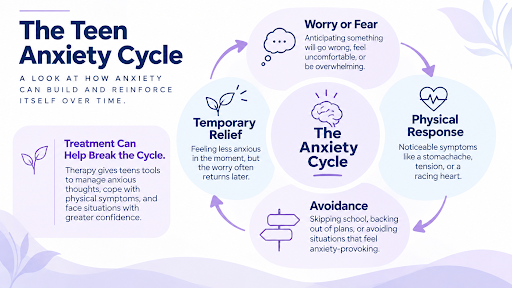
Anxiety sometimes occurs alongside other mental health conditions, including depression. A teenager who constantly worries about disappointing others may also begin withdrawing from friends, losing interest in activities, or feeling hopeless.
When symptoms overlap, addressing both concerns may be important. Bloom also provides teen depression treatment for adolescents who need support managing depression and related mental health symptoms.
Safety must come first. If your teenager is talking about wanting to die, engaging in self-harm, or is at immediate risk of hurting themselves or someone else, emergency or inpatient psychiatric care may be necessary before outpatient treatment.
If your teen is in immediate danger, call 911 or go to the nearest emergency room. You can also call or text 988 to reach the Suicide & Crisis Lifeline.
Anxiety can affect teenagers in very different ways. One teen may attend school but experience frequent panic attacks, while another may be unable to leave home for classes or social activities.
Bloom offers two outpatient programs that provide different levels of therapeutic support. Both are designed for teenagers who can safely return home after treatment sessions.
Our partial hospitalization program provides intensive daytime treatment for teens whose anxiety is significantly interfering with school attendance, relationships, and daily responsibilities.
PHP operates Monday through Friday, from 9 AM to 3:30 PM.
This level of care may be appropriate for a teenager who:
PHP includes therapeutic services that help teens practice managing anxiety while receiving consistent clinical support.
Our intensive outpatient program provides structured treatment for teenagers who need more frequent care than traditional counseling but don’t require a full day of programming.
IOP operates from 9 AM to 12:30 PM, three, four, or five days per week, depending on the teen’s needs.
A teenager who continues attending school but experiences persistent worry, panic symptoms, or growing avoidance may benefit from IOP.
Some teens begin treatment in IOP, while others transition from PHP as they make progress and need less intensive support.
The appropriate level of care depends on your teen’s symptoms, safety, and ability to manage daily activities. You can learn more about how PHP and IOP compare or contact Bloom to discuss your teenager’s needs.
Telling a teenager to stop worrying rarely changes how they feel. They may understand that their fears seem unreasonable and still struggle to control the thoughts and physical sensations that accompany anxiety.
Effective treatment gives teens opportunities to recognize anxious thinking, respond differently to difficult emotions, and develop practical coping skills.
Cognitive behavioral therapy (CBT) is a well-established treatment for anxiety disorders. According to the National Institute of Mental Health, CBT helps people recognize unhelpful patterns of thinking and behavior and develop healthier responses to stressful situations (2).
Bloom combines CBT with other therapeutic approaches to support adolescents experiencing anxiety.
Cognitive behavioral therapy helps teenagers examine the relationship between their thoughts, feelings, and actions.
For example, a teen who assumes that one poor grade means they’re failing at school may learn to question that conclusion and consider a more balanced perspective.
Dialectical behavior therapy (DBT) focuses on skills for managing strong emotions, tolerating distress, and communicating more effectively.
At Bloom, teens may practice recognizing when anxiety is escalating, responding to overwhelming feelings, and using coping strategies rather than automatically avoiding uncomfortable situations.
Some teenagers find it easier to discuss their fears privately, while others benefit from discovering that their peers experience similar challenges.
Individual therapy allows teens to explore personal concerns, identify patterns of anxious thinking, and practice skills with a therapist.
Group therapy allows adolescents to work on communication, emotional regulation, and coping strategies alongside other teenagers receiving mental health treatment.
For teens experiencing social anxiety, participating in a supportive group may also provide opportunities to practice expressing themselves and interacting with peers.
Anxiety rarely affects just one member of a household. Parents may find themselves changing schedules, answering repeated reassurance questions, or helping their teenager avoid situations that cause distress.
These responses often come from a genuine desire to help. However, families sometimes need guidance on how to offer support without reinforcing patterns of avoidance.
Through family therapy, Bloom helps parents better understand their teenager’s anxiety and develop more effective ways to respond.
Parents may work on setting reasonable expectations, communicating during anxious moments, and encouraging their teen to practice the coping skills they’re developing in treatment.
Not every teenager feels comfortable sitting across from a therapist and talking about their worries.
Bloom offers experiential activities, including expressive arts, music, drama, and movement, that give teens additional ways to participate in treatment.
These activities can be especially helpful for adolescents who struggle to put their feelings into words or become overwhelmed during traditional conversations.
Every adolescent entering treatment at Bloom receives an initial psychiatric evaluation.
This evaluation helps clinicians assess mental health symptoms and determine whether medication may be appropriate as part of the teen’s treatment plan.
When medication is prescribed, Bloom provides weekly or biweekly medication management to monitor symptoms, evaluate the teen’s response, and address concerns.
Medication isn’t necessary for every teenager. Treatment recommendations depend on each adolescent’s individual needs and clinical assessment.
If you’ve spent months trying to help your teenager manage anxiety, you may be wondering what else you can do. Reaching out for professional guidance can help you understand whether a more structured treatment program is appropriate.
Bloom Adolescent Health provides anxiety treatment for teens ages 11 to 18 at 235 West Central St, Natick, MA 01760.
Call us at (781) 427-2634 to talk about what’s been happening with your teen and explore available treatment options. Having your insurance card and a few notes about your teenager’s symptoms can make that conversation easier.
You can also check your insurance online to learn more about your coverage for adolescent mental health treatment.
Both Bloom programs operate during school hours. PHP runs Monday through Friday, from 9 AM to 3:30 PM, and takes the place of the regular school day. IOP runs from 9 AM to 12:30 PM, three to five days per week, so it also overlaps with morning classes. Parents should consider these schedules when choosing treatment.
It’s common for teenagers to feel uncertain or resistant when parents suggest mental health treatment. Your teen may worry about meeting unfamiliar people, discussing personal experiences, or being away from their usual routine. Listen to their concerns and explain why you’re considering additional support. Bloom’s admissions team can answer questions about the programs so your family can better understand what treatment involves.
Bloom’s IOP operates three, four, or five days per week, from 9 AM to 12:30 PM. The number of treatment days depends on your teenager’s individual needs and the level of support recommended following assessment.
Medication may be included when clinically appropriate, but it isn’t required for every teenager. Each teen receives an initial psychiatric evaluation, and those who are prescribed medication receive weekly or biweekly medication management. Therapy and coping skills remain important components of Bloom’s treatment approach.

Simone “Momo” is a sweet 2-year-old Lab mix who believes life is best spent doing three things: snuggling, napping, and playing with her toys—then repeating the whole process!
She absolutely loves her treats, but there’s one snack that has her heart: blueberries! Whether she’s curled up beside her favorite people or happily playing with her toys, Simone is happiest when she’s surrounded by love, comfort, and plenty of cuddles.

Richie is a 5-year-old Mini Goldendoodle who has a few favorite things: getting spoiled with pets, scoring tasty treats, playing with his favorite toys, and snuggling up close!
He’s got a big personality, an even bigger heart, and plenty of love to share.