

If your teen is in immediate danger, call 911 or go to the nearest emergency room. For immediate emotional support, call or text 988 to reach the Suicide & Crisis Lifeline.
For families currently receiving treatment at Bloom Adolescent Health, an on-call clinician is available after hours at (781) 427-2634 to assess concerns and help determine the next step, including emergency or crisis services when necessary.
Finding out that your teenager is hurting themselves or thinking about suicide can be frightening. You may feel overwhelmed, uncertain about what to say, or afraid that asking questions will make things worse. What’s important to understand is that your teen needs compassion, professional attention, and support, not judgment or punishment.
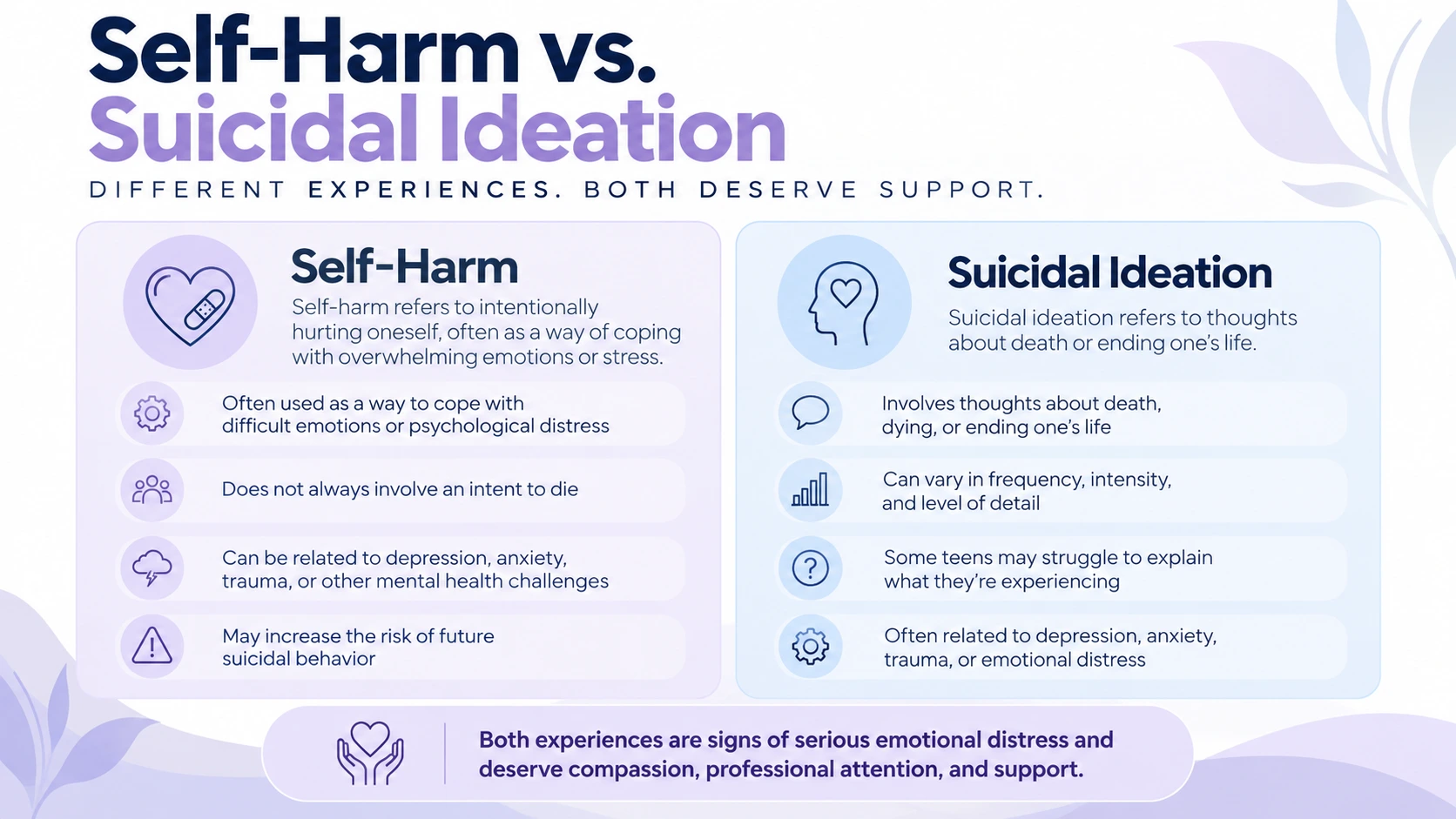
Self-harm and suicidal thoughts are different experiences, although they can occur together. Both can indicate serious emotional distress and deserve careful attention.
Bloom Adolescent Health provides outpatient mental health treatment for adolescents ages 11 to 18 in Natick, Massachusetts. Our partial hospitalization program (PHP) and intensive outpatient program (IOP) may be appropriate for teens experiencing self-harm or suicidal thoughts who have been assessed and can safely remain at home outside treatment hours.
As part of our broader teen mental health treatment services, Bloom helps adolescents develop coping skills, manage difficult emotions, and receive structured therapeutic support.
Self-harm refers to intentionally hurting oneself, often as a way of coping with overwhelming emotions or psychological distress. It doesn’t always involve an intention to die, although it can increase the risk of future suicidal behavior.
Suicidal ideation refers to thoughts about death or ending one’s life. These thoughts can vary in frequency and intensity, and some teens may struggle to explain what they’re experiencing.
Self-harm isn’t necessarily a suicide attempt, but neither experience should be dismissed or minimized. A teenager may be struggling with depression, anxiety, trauma, or emotions they don’t know how to manage. Some adolescents experience both self-harm and suicidal thoughts.
It’s important not to assume that your teen is seeking attention or trying to manipulate others. These behaviors and thoughts deserve a supportive response and professional assessment.
The National Institute of Mental Health (NIMH) emphasizes that suicidal statements and behaviors are signs of serious distress that should always be taken seriously (1).
If your teenager has experienced self-harm or suicidal thoughts, the priority is determining what level of care can safely meet their needs.
Some teens benefit from structured outpatient treatment that provides more support than weekly therapy while allowing them to continue living at home. Others need immediate psychiatric stabilization or around-the-clock supervision before outpatient care can be considered.
Bloom screens every teenager at admission to assess their safety and determine whether outpatient treatment is appropriate.
Bloom’s partial hospitalization and intensive outpatient programs may be suitable for adolescents who have experienced suicidal thoughts or self-harm but have been assessed as safe enough to return home after treatment sessions.
These programs provide different levels of structured therapeutic care:
Both programs include therapeutic services that help teens manage emotional distress and practice healthier coping skills.
A teenager may also enter Bloom after receiving inpatient psychiatric treatment, provided they’re stable enough to participate safely in outpatient care.
Outpatient treatment isn’t appropriate when a teenager faces an immediate safety risk.
A teen who has a current suicide plan or intent, has recently attempted suicide, or cannot remain safe at home may need emergency evaluation or inpatient psychiatric care.
If you’re concerned that your teenager may act on suicidal thoughts or is in immediate danger, call 911 or go to the nearest emergency room. You can also call or text 988 for crisis support.
Once your teenager is safe and clinically ready to return home, Bloom may be an appropriate step-down treatment option.
Teenagers experiencing self-harm or suicidal thoughts may struggle with emotions that feel difficult to explain or control. Some have trouble asking for help, while others withdraw from family members because they’re afraid of how people will react.
Treatment can help adolescents develop safer ways to respond to distress and communicate what they’re experiencing. Bloom uses several therapeutic approaches, with services guided by each teenager’s clinical needs.
Dialectical behavior therapy (DBT) helps teenagers develop skills for managing intense emotions, tolerating distress, and responding to difficult situations.
Rather than expecting a teen to simply stop feeling overwhelmed, DBT focuses on what they can practice when distress becomes difficult to manage.
Research published in JAMA Psychiatry found that DBT was effective in reducing self-harm and suicide attempts among adolescents at high risk for suicide (2).
At Bloom, DBT for teens is part of the therapeutic approach used to help adolescents strengthen emotional regulation and coping skills.
Individual therapy gives teenagers an opportunity to discuss personal concerns privately with a mental health professional. Sessions may focus on difficult emotions, patterns of thinking, communication, and developing healthier ways to respond to distress.
Group therapy provides a supportive setting where teens can practice coping skills and connect with peers who are working through their own mental health challenges.
For adolescents who feel isolated or misunderstood, participating in therapy alongside others can create opportunities for connection without requiring them to share experiences they’re uncomfortable discussing.
Learning that your teenager is experiencing self-harm or suicidal thoughts may leave you questioning what you could have done differently. You might feel frightened about leaving them alone or unsure how to talk about what happened.
Through family therapy, Bloom helps parents and caregivers understand their teen’s emotional needs and develop more supportive ways to communicate.
This may include learning how to respond when your teenager expresses distress, discussing difficult feelings without judgment, and recognizing when additional professional support is needed.
Family therapy also provides an opportunity to address tension or communication difficulties that may make it harder for teenagers to ask for help.
Your teen doesn’t need to face these challenges alone, and neither does your family.
Every adolescent entering Bloom receives an initial psychiatric evaluation to assess mental health symptoms and treatment needs.
When clinically appropriate, medication may be included in a teenager’s treatment plan. Bloom provides weekly or biweekly medication management when medication is prescribed.
Psychiatric care can be especially important when suicidal thoughts or self-harm occur alongside other conditions, such as depression or anxiety. Learn more about our teen depression treatment services.
Medication isn’t automatically prescribed to every teenager. Treatment recommendations depend on individual clinical needs and professional assessment.
If you’ve been hurting yourself or having thoughts about suicide, you deserve to be heard and taken seriously. You aren’t in trouble for having these feelings, and asking for help is a meaningful first step.
Tell a trusted adult what you’re experiencing, even if you’re not sure how to explain everything. You can also call or text 988 to talk with someone who can help you through a difficult moment.
Visit our guide for teens to learn more about getting mental health support.
If you’ve recently discovered signs of self-harm or learned that your teenager has been thinking about suicide, it’s important to respond with care and take their concerns seriously.
Stay with your teen while you assess the situation, listen without judgment, and ask directly whether they’re thinking about suicide. Research shows that asking someone about suicidal thoughts does not increase those thoughts or encourage suicidal behavior (1).
If your teen is in immediate danger, call 911 or go to the nearest emergency room. For immediate crisis support, call or text 988.
When there’s no immediate danger, Bloom Adolescent Health can help you explore whether structured outpatient treatment may be appropriate. We are located at 235 West Central St, Natick, MA 01760.
Call (781) 427-2634 to speak with our admissions team about your concerns and learn about available treatment options. You can also verify your insurance online to explore your coverage.
For additional information about supporting your teenager, visit our guide for parents.
Respond calmly and let your teenager know you want to help. Avoid blaming, shaming, or punishing them for what you’ve discovered. Ask how they’re feeling and whether they’re having thoughts of suicide. Arrange a prompt professional assessment, even if your teen says they weren’t trying to end their life. If there’s immediate danger or a serious injury, call 911 or seek emergency medical care.
No. Research shows that asking someone directly about suicidal thoughts doesn’t increase the likelihood of suicidal behavior or introduce the idea of suicide (1). Asking calmly and listening without judgment can help your teen feel more comfortable sharing what they’re experiencing. If they tell you they’re thinking about suicide, take their concerns seriously and seek appropriate professional support.
Yes, Bloom may be an appropriate treatment option for adolescents who have completed inpatient psychiatric care and are ready to return home. Our PHP and IOP provide structured outpatient mental health treatment for teens who no longer require around-the-clock supervision. Admission depends on a clinical assessment of your teenager’s current needs and safety.
Bloom has a clinician available after hours for families currently receiving treatment. The clinician can assess the situation and determine the appropriate next step, which may include an emergency room or crisis service. Current families can reach the on-call clinician at (781) 427-2634. For immediate danger, call 911 or go to the nearest emergency room. You can also call or text 988 for crisis support.

Simone “Momo” is a sweet 2-year-old Lab mix who believes life is best spent doing three things: snuggling, napping, and playing with her toys—then repeating the whole process!
She absolutely loves her treats, but there’s one snack that has her heart: blueberries! Whether she’s curled up beside her favorite people or happily playing with her toys, Simone is happiest when she’s surrounded by love, comfort, and plenty of cuddles.

Richie is a 5-year-old Mini Goldendoodle who has a few favorite things: getting spoiled with pets, scoring tasty treats, playing with his favorite toys, and snuggling up close!
He’s got a big personality, an even bigger heart, and plenty of love to share.